In classical East Asian physiognomy (Mian Xiang, 面相), facial moles are cataloged under a specialized branch called Zhi Xiang (痣相)—the observation of surface marks in relation to underlying facial geography. Manuals compiled from the Song through Ming dynasties, including the Ma Yi Shen Xiang (麻衣神相) and the Shen Xiang Quan Bian (神相全编), treat a mole not as an isolated omen, but as punctuation placed upon an existing landscape of bone, muscle, and complexion.
Popular modern diagrams often reduce face reading moles to a single coordinate grid, claiming that a spot in one millimeter of skin automatically brings wealth or friction. Traditional treatises reject that simplification. Before assigning any symbolic meaning to a location, an experienced observer asks two prior questions: what is the surface quality of the mark itself, and which zone of the Twelve Palaces (Shi Er Gong, 十二宫) on a classical Chinese face reading chart does it occupy?
Beyond Placement: Color, Luster, and Form
In moles Chinese face reading traditions, the visual character of a mark carries greater weight than its mere coordinates. Compendia consistently divide marks into "living moles" (huo zhi, 活痣) and "dull moles" (si zhi, 死痣), a classification based entirely on surface tone, clarity, and elevation.
Living Marks vs. Dull Marks
A classic huo zhi exhibits clean saturation and a slight sheen, as though light rests comfortably on its surface. Traditional texts single out two hues as especially harmonious:
- Lacquer black (qi hei, 漆黑): Deep, even pigment with a subtle gloss rather than a flat matte finish.
- Vermilion or warm amber (zhu sha, 朱砂 / hong zhi, 红痣): Clear reddish or warm-brown tones that blend smoothly with healthy facial complexion.
By contrast, a si zhi appears chalky, grayish, muddy, or unevenly smudged into the surrounding skin. Classical commentators associate clear, luminous marks with decisive expression in their corresponding palace, whereas murky or indistinct marks are read as areas requiring extra patience, deliberate habits, or clearer boundaries.
Elevation, Shape, and Border Clarity
Shape and contour refine the reading further. A round, compact, slightly raised mark with crisp edges is traditionally favored over a flat, jagged, or elongated smudge. Manual authors also note whether a mark grows fine hair—known metaphorically as "a mountain bearing timber" (shan you lin mu)—viewing neat, intact texture as a sign of steady vitality rather than depletion. Equally important is proportion: a tiny pinprick mark rarely overrides strong bone structure, whereas a prominent mark at the center of a narrow or shadowed zone draws more interpretive attention.
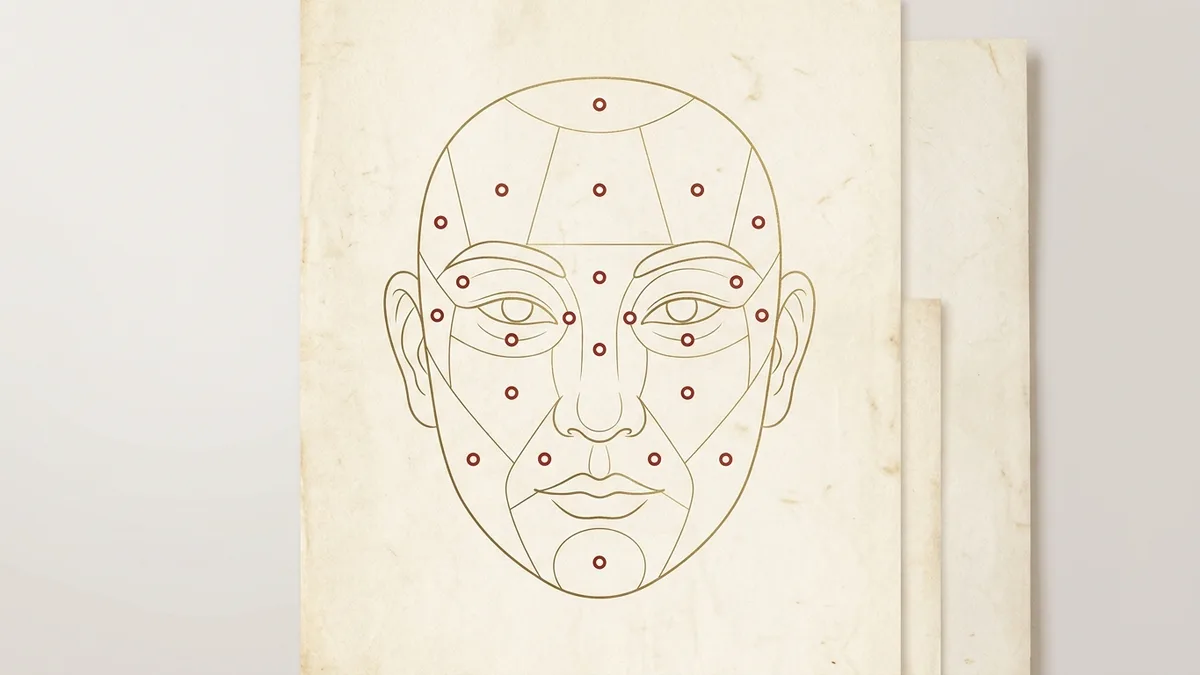
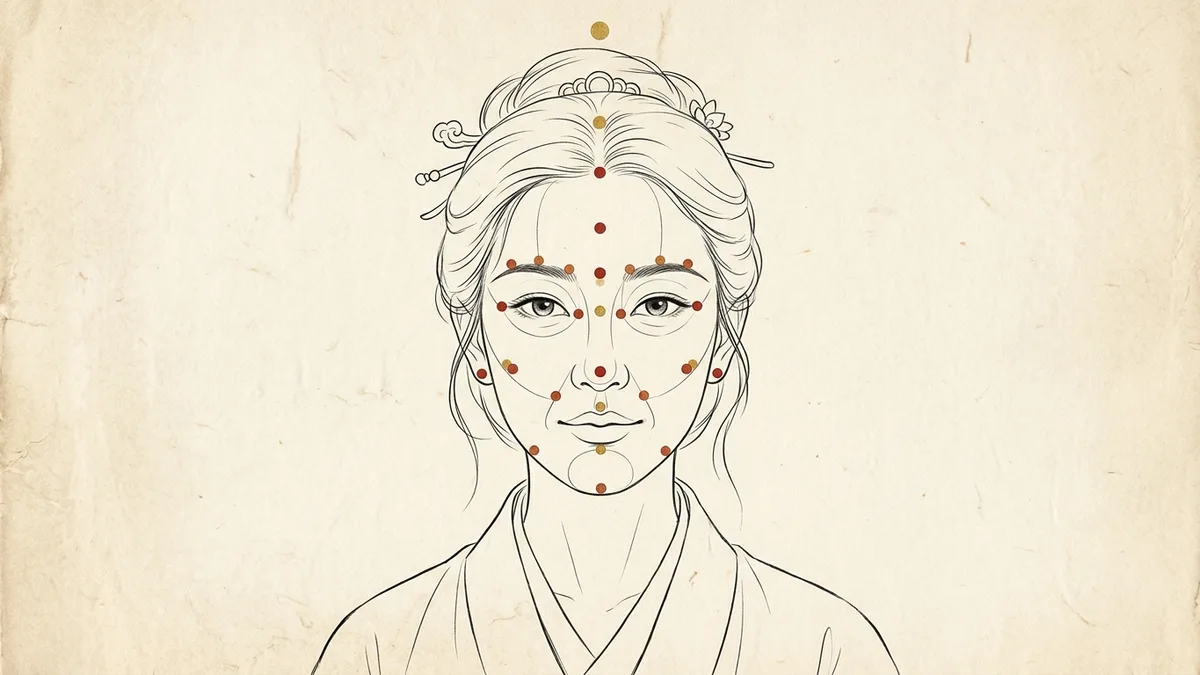
Classical Moles Chart Across the Twelve Palaces
Rather than memorizing dozens of disconnected folklore rules, classical Chinese physiognomy anchors mole interpretation inside the interactive Mian Xiang Twelve Palaces analyzer. Each palace represents a recurring domain of adult life—such as career pacing, domestic atmosphere, travel, or personal stamina—and a mark within that zone acts as an accent mark on how that domain tends to unfold.
| Facial Zone & Palace | Chinese Term | Traditional Symbolic Domain | Living Mark vs. Dull Mark Reading |
|---|---|---|---|
| Center of forehead (Career Palace) | 官禄宫 (Guan Lu Gong) | Public role, organizational standing, planning | Clear mark suggests focused ambition; dull mark points to uneven pacing in early career |
| Above outer brow (Travel Palace) | 迁移宫 (Qian Yi Gong) | Mobility, relocation, cross-regional work | Glossy mark favors smooth adaptation abroad; flat mark calls for careful logistics |
| Between eyebrows (Life Palace) | 命宫 (Ming Gong) | Core temperament, judgment, clarity of mind | Rare bright mark signals strong resolve; smudged mark reflects tendency to overthink |
| Nose bridge between eyes (Vitality & Stamina Palace) | 疾厄宫 (Ji E Gong) | Everyday vitality, stamina reserves, rest rhythm | Clean tone reflects steady recovery; shadowed mark highlights need for consistent sleep |
| Nose tip and wings (Wealth Palace) | 财帛宫 (Cai Bo Gong) | Cash flow habits, resource stewardship, generosity | Distinct mark on nose wing suggests active earning; dull mark cautions against impulsive spending |
| Outer eye corners (Marriage Palace) | 夫妻宫 (Fu Qi Gong) | Partnership dynamics, emotional reciprocity | Smooth mark indicates expressive warmth; muddy mark points to recurring communication friction |
| Under-eye hollows (Children Palace) | 子女宫 (Zi Nu Gong) | Nurturing capacity, creative output, family care | Bright, even mark suggests attentive care; darkened mark signals fatigue from overcommitting |
| Upper eyelids (Property Palace) | 田宅宫 (Tian Zhai Gong) | Home environment, savings, long-term stability | Clear mark favors grounded domestic routines; irregular mark reflects frequent household shifts |
| Eyebrow body and arch (Siblings Palace) | 兄弟宫 (Xiong Di Gong) | Peer alliances, sibling bonds, cooperative rhythm | Concealed bright mark signals quiet resourcefulness; dull mark at brow tail calls for steadier peer boundaries |
| Above outer brow tails (Fortune Palace) | 福德宫 (Fu De Gong) | Mental poise, perspective, everyday contentment | Clear mark near Tian Cang reflects calm perspective; flat mark advises guarding against restless overwork |
| Upper lateral frontal eminences (Parents Palace · Ri Yue Jiao) | 父母宫 (Fu Mu Gong) | Ancestral support, mentors, early guidance | Well-formed mark suggests constructive mentorship; faint mark points to self-made independence |
| Lower chin flanks and jaw perimeter (Servants Palace) | 奴仆宫 (Nu Pu Gong) | Team rapport, collaborators, late-life support | Balanced mark indicates loyal allies; uneven mark encourages clearer delegation |
Symmetry and Left-Right Distinctions
Classical texts often cross-reference the left and right sides of the face, traditionally associating the left side with public, outward, or paternal influences and the right side with private, internal, or maternal spheres. However, careful readers treat bilateral symmetry as more informative than rigid left-right formulas. When a mark sits directly along the central axis—such as the forehead midpoint, nose ridge, or philtrum—it is read as shaping personal agency directly, whereas lateral marks tend to describe how a person interacts with partners, peers, or changing environments.
Notable Zones: Hidden Brows, Tear Troughs, and Outer Corners
Several facial locations appear repeatedly in historical commentary because they sit at intersections between emotion, expression, and social perception.
Concealed Brow Marks (Mei Li Cang Zhu)
A clear mark tucked cleanly inside the eyebrow hair—referred to in classical idioms as "a pearl hidden in the grass" (cao li cang zhu)—is one of the most celebrated placements in Zhi Xiang. Because the eyebrow (Bao Shou Guan) frames how someone regulates impulse and protects composure, a bright, concealed mark is traditionally read as quiet resourcefulness: practical capability that does not advertise itself loudly. Conversely, a flat or grayish mark sitting just outside the brow tail is read as a reminder to guard against scattered commitments.
Tear Troughs and Outer Eye Corners
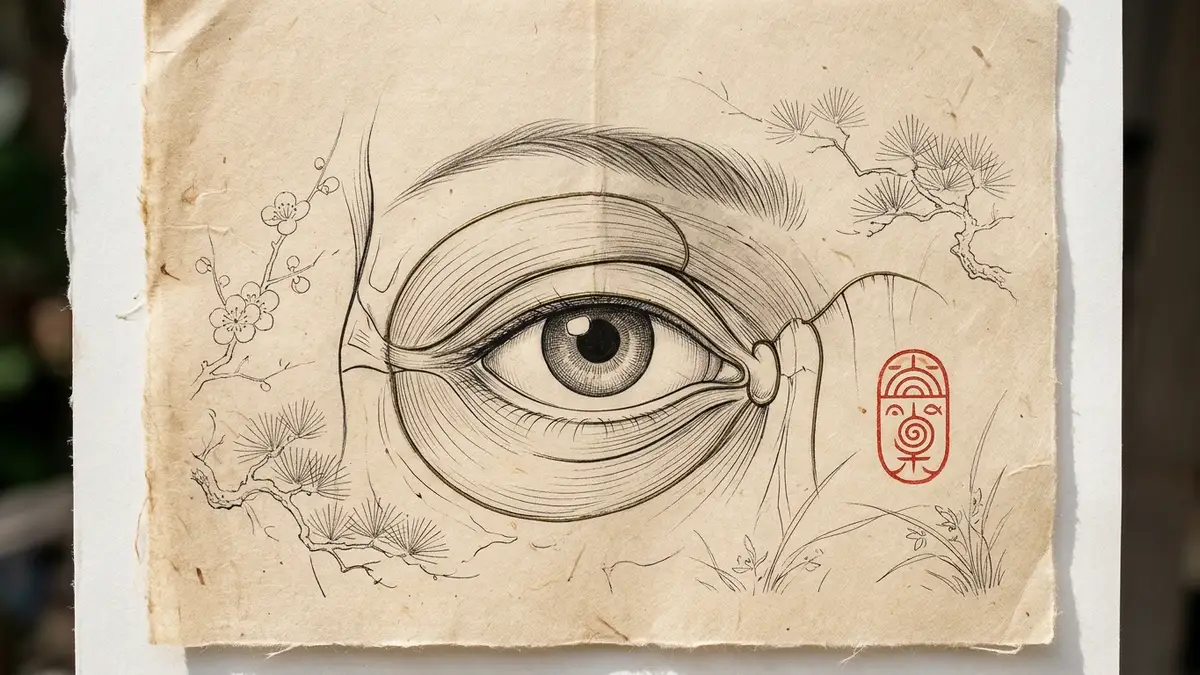
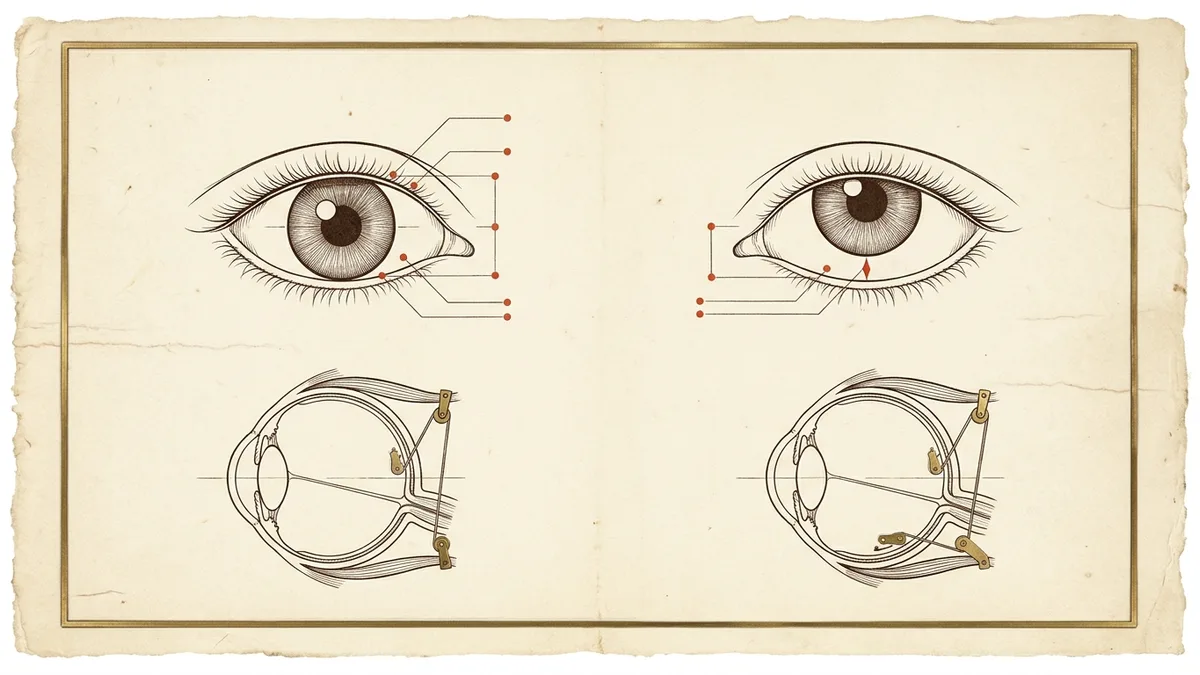
Marks along the lower eyelid (Zi Nu Gong) or at the outer canthus (Yu Wei, the Marriage Palace) receive nuanced treatment because the eyes dominate social expression. Classical observers pair any mark near the eye with the surrounding eye shape and sclera visibility—explored in depth in our guide to peach blossom eyes in Chinese face reading. A clean, bright mark near the outer corner is associated with strong interpersonal magnetism, while a dull mark in the same spot often reflects emotional restlessness when expectations in close relationships go unspoken.
Cultural Cartography vs. Dermatological Care
Distinguishing symbolic tradition from clinical skin care is essential when approaching any classical moles chart. Mian Xiang developed as a pre-modern observational language for character, social rhythm, and aesthetic proportion—a cultural lens shaped by calligraphy, portraiture, and Confucian self-cultivation. It is not a diagnostic system and never substitutes for dermatological evaluation.
Any mole that changes in size, border irregularity, color variation, or surface texture belongs with a qualified dermatologist, regardless of where it sits on a traditional chart. Within its proper cultural frame, however, Zhi Xiang remains a thoughtful framework for noticing facial balance and reflecting on how habits, rest, and temperament express themselves across the Twelve Palaces. You can compare palace pins on our Chinese face reading chart, browse a sample Mian Xiang report, or map your own proportions in the interactive Mian Xiang Twelve Palaces analyzer.