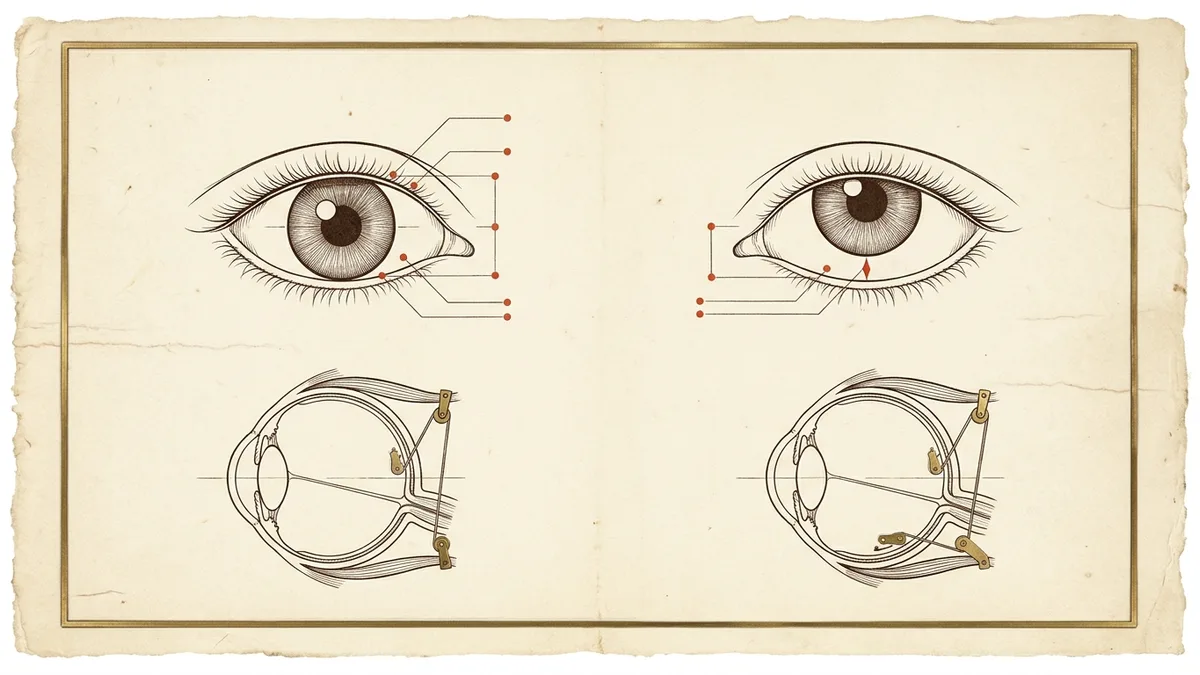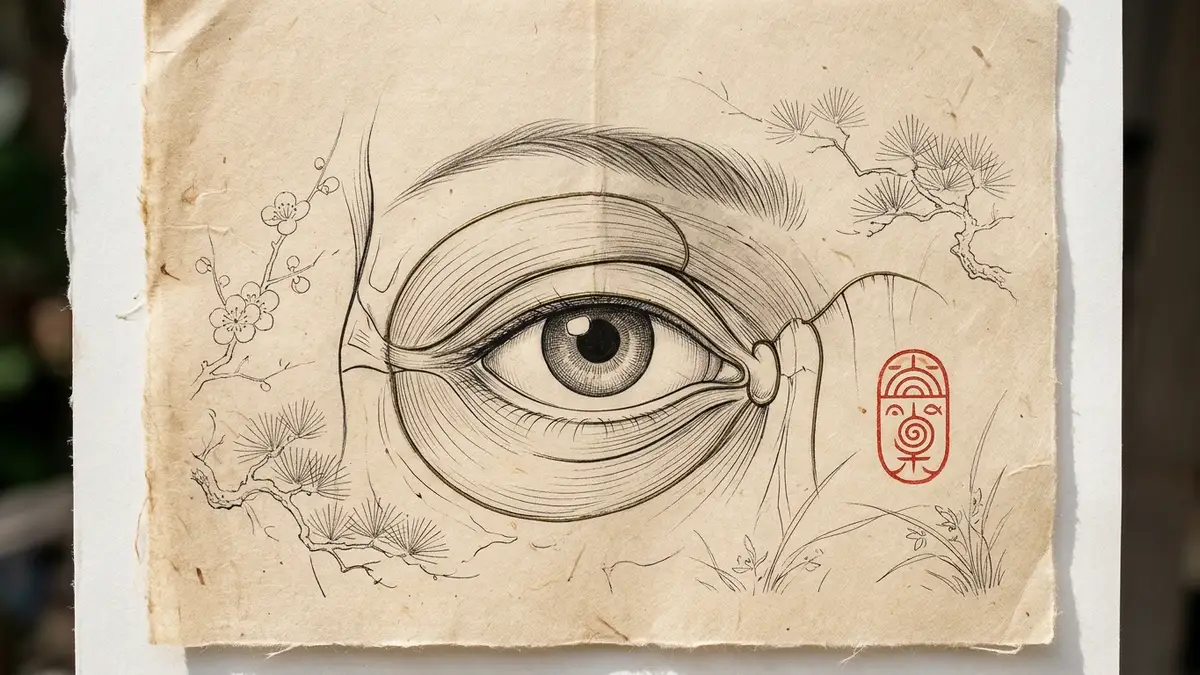
In classical Chinese physiognomy (Mian Xiang / 面相), Tao Hua Yan (桃花眼)—literally "Peach Blossom Eyes"—ranks among the most celebrated and most frequently misidentified eye shapes. Named for the supple curvature of a spring peach petal, this form is defined in classical portrait manuals not by vague attractiveness, but by measurable geometric landmarks: a gently hooked medial (inner) canthus, a rounded central lid arch, a softly upturned lateral (outer) tail, and luminous corneal reflection.
Modern social media trends often blur Peach Blossom eyes with any large, expressive, or winged-eyeliner look. Traditional texts such as Shen Xiang Quan Bian (神相全编) draw far sharper boundaries, distinguishing Tao Hua Yan from both the elongated Dan Feng Yan (丹凤眼 / Phoenix Eyes) and the balanced Xing Ren Yan (杏仁眼 / Almond Eyes). Reading the peach blossom eye shape accurately requires examining canthal angles, lid curvature, and muscular softness around the lower margin.
Anatomical Landmarks of Peach Blossom Eyes
A genuine Tao Hua Yan presentation combines three distinct structural features that give the eye its characteristic petal silhouette.
Hooked Medial Canthus and Rounded Lid Dome
At the inner corner toward the nasal bridge, the medial canthus of a Peach Blossom eye tapers into a delicate, slightly downward-curving point—analogous to the narrow base of a petal. Moving across the pupil, the upper eyelid rises into a generous, smooth arch rather than a flat horizontal line. That vertical dome exposes a clean expanse of the iris and allows light to catch the cornea easily, giving the gaze openness without appearing startled.
Lateral Tail Lift, Lower-Lid Curve, and Wo Can (卧蚕)
Toward the temple, the upper lid tapers softly into a subtle upward sweep at the Yu Wei (鱼尾, or Fish Tail), yet remains rounder and less razor-edged than a Phoenix eye. Meanwhile, the lower eyelid traces a gentle S-shaped undulation instead of a rigid straight border. Directly below the lower lash line, many individuals with Tao Hua Yan display Wo Can (卧蚕)—the "lying silkworm," a smooth three-to-five-millimeter muscular fullness formed by the orbicularis oculi that becomes especially visible during a relaxed smile. Anatomically, Wo Can softens the lower orbital border and creates natural warmth even before a person speaks.
Corneal Clarity and Gaze Warmth (Shui Shen / 水神)
Classical treatises frequently describe Peach Blossom eyes as Dai Shui (带水)—carrying a clear, watery sheen. In observational anatomy, this reflects a healthy, even tear film across the cornea paired with responsive pupil engagement and relaxed brow muscles. Rather than a blank stare or tight squint, the gaze maintains gentle focus that draws conversational partners in effortlessly.
Peach Blossom Eyes vs. Phoenix Eyes and Almond Eyes
Because all three classical categories represent harmonious proportions, casual observers often confuse them. Comparing their horizontal-to-vertical ratios and canthal geometry makes the distinctions clear.
Phoenix Eyes (Dan Feng Yan / 丹凤眼)
Dan Feng Yan (丹凤眼) features a significantly longer horizontal span relative to its vertical opening. Both upper and lower lids stay taut and streamlined, while the lateral canthus sits noticeably higher than the medial canthus, forming a clean diagonal lift toward the temple. Where Peach Blossom eyes curve upward in a rounded petal arc and feel immediately approachable, Phoenix eyes project composed restraint, executive poise, and quiet strategic distance.
Almond Eyes (Xing Ren Yan / 杏仁眼)
Xing Ren Yan (杏仁眼) represents classical elliptical symmetry. The inner and outer corners rest close to a level horizontal axis, the vertical opening is moderate rather than deep, and the upper lid crests evenly over the center of the pupil without a pronounced inner hook or dramatic outer tail sweep. Almond eyes signal steady day-to-day balance and measured judgment, lacking the stylized petal curvature of Tao Hua Yan.
Key Geometric Distinctions
In short, Peach Blossom eyes sit at a precise midpoint: taller and rounder through the central lid than Phoenix eyes, yet more sculpted at both corners than Almond eyes. Without the hooked medial point, soft lower-lid curve, and luminous gaze quality together, an eye typically belongs to Xing Ren Yan or a hybrid variation rather than true Tao Hua Yan.
Comparison Table: Peach Blossom, Phoenix, and Almond Eyes
| Feature | Classical Name | Anatomical Cue | Traditional Observation |
|---|---|---|---|
| Peach Blossom Eyes | Tao Hua Yan (桃花眼) | Hooked inner canthus, rounded central lid dome, soft upturned outer tail, subtle S-curve lower lid | High interpersonal magnetism, expressive warmth, strong artistic and social attunement |
| Phoenix Eyes | Dan Feng Yan (丹凤眼) | Narrow vertical aperture, elongated horizontal length, taut lids, clear upward outer-canthus tilt | Composed authority, disciplined focus, long-range strategic temperament |
| Almond Eyes | Xing Ren Yan (杏仁眼) | Balanced oval symmetry, moderate vertical height, nearly level inner-to-outer canthus axis | Steady judgment, approachable equilibrium, consistent adaptability |
| Lying Silkworm Ridge | Wo Can (卧蚕) | Smooth 3–5 mm muscular fullness directly beneath the lower lashes at rest or smile | Expressive empathy and natural rapport, distinct from fatigued lower-lid puffiness |
Classical Context, Social Reading, and Practical Verification
Moving Beyond Romantic Stereotypes
Modern pop culture often treats Tao Hua Yan solely as a marker of romantic attention. Classical Mian Xiang offers a broader, more practical reading. In traditional social observation, Peach Blossom eyes indicate heightened interpersonal sensitivity—the ability to read subtle shifts in mood, build trust rapidly, and hold attention in conversation. Those qualities naturally support roles in diplomacy, teaching, design, performance, hospitality, and collaborative leadership. Classical texts note that strong social magnetism simply amplifies visibility; how someone channels that rapport depends on overall facial composure and personal discipline.
Lighting, Makeup, and Holistic Proportion
Evaluating Tao Hua Yan accurately requires looking past cosmetic illusion. Winged eyeliner, inner-corner highlighting, and under-eye shading routinely imitate a hooked canthus, upturned outer tail, and Wo Can ridge on Almond or round eyes. Likewise, genuine Wo Can sits snugly against the lower lash margin as firm muscle tone, whereas temporary under-eye puffiness sits lower on the orbital rim and softens definition. Classical readers always assess an unposed, makeup-free face under neutral frontal light.
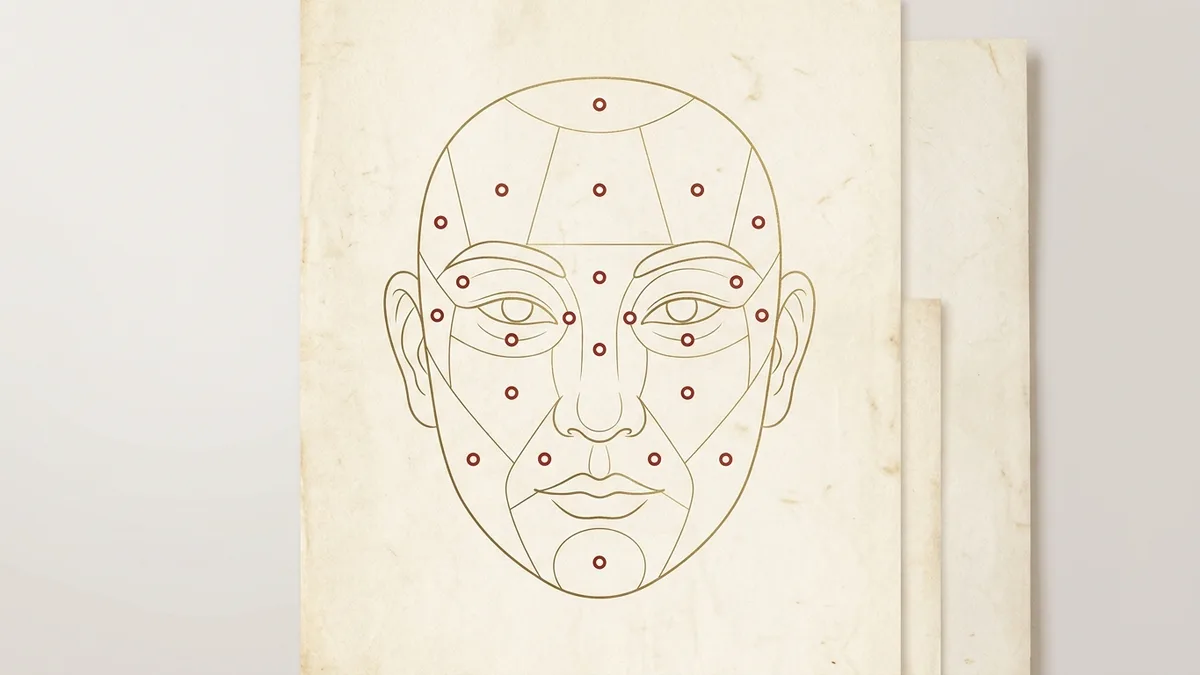
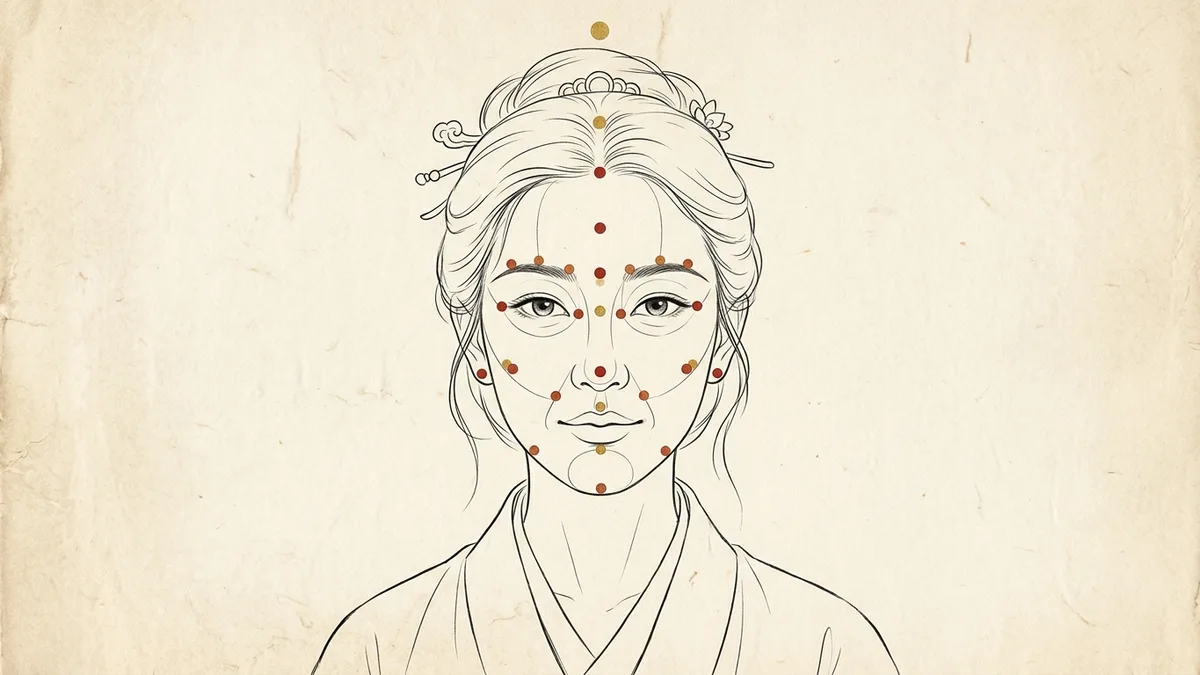
As with all eye classifications in Chinese Face Reading, Tao Hua Yan is never interpreted in isolation from adjacent facial zones. Observers check the Yu Wei (outer corner) for smooth, unstrained tone, the brows for balanced framing, and the Health Palace (Ji E Gong / 疾厄宫) across the upper nasal bridge—which classical physiognomy associates with everyday vitality, stamina reserves, and rest rhythm. When bright gaze warmth is backed by steady rest rhythm and proportional brow spacing, the social ease of Peach Blossom eyes remains grounded and sustainable.
If you are curious how your own canthal tilt, aperture height, and lid symmetry measure against classical reference proportions, inspect a free online face reading sample report, review Wo Can and Tao Hua Yan in the Mian Xiang face reading glossary, or upload a level portrait to the free Chinese Face Reading analyzer. Viewed through concrete anatomical geometry rather than folklore, Tao Hua Yan stands out as an enduring study in curvature, light reflection, and human expressiveness.