Classical Chinese physiognomy, known as Mian Xiang (面相), approaches the human face the way an architectural surveyor studies a courtyard compound: by measuring vertical proportions, inspecting key structural gateways, and mapping functional rooms before interpreting smaller surface details. Codified across centuries in foundational texts such as the Ma Yi Shen Xiang (麻衣神相) and Liu Zhuang Xiang Fa (柳庄相法), this three-part framework—the Three Courtyards (San Ting), the Five Officers (Wu Guan), and the Twelve Palaces (Shi Er Gong)—provides an orderly grammar for observing human expression and temperament.
Because both Mian Xiang and Traditional Chinese Medicine (TCM) examine the face closely, modern readers frequently conflate the two disciplines. Understanding where classical physiognomic mapping overlaps with face reading in Chinese medicine—and where the two traditions diverge sharply—keeps each practice grounded in its proper historical context.
The Three Courtyards (San Ting): Reading Vertical Proportion
Before examining individual features, a classical reader divides the face horizontally into three tiers called the Three Courtyards (San Ting, 三停). Think of them as a timeline of life focus and a measure of structural balance across the skull and jaw.
Upper, Middle, and Lower Courtyards
- Upper Courtyard (Shang Ting, 上停): Extending from the natural hairline to the midpoint between the eyebrows (Yin Tang). Traditionally associated with youth and early adulthood, it reflects conceptual thinking, intellectual curiosity, and early family or educational foundations.
- Middle Courtyard (Zhong Ting, 中停): Running from the brow line down to the base of the nose tip. Associated with prime working decades, this tier reflects drive, execution, self-assertion, and how a person navigates competitive environments.
- Lower Courtyard (Xia Ting, 下停): Spanning from beneath the nose through the philtrum, mouth, and chin. Linked with later maturity, it represents consolidation, practical endurance, domestic stability, and interpersonal warmth.
Classical manuals prize balanced height and fullness across all three tiers—a configuration called San Ting Ping Deng (三停平等)—interpreting even proportions as steady pacing across life stages. Yet uneven proportions are not treated as flaws; rather, a tall Upper Courtyard paired with a lighter jaw often characterizes someone who thrives in analytical or advisory work before settling into routine later in life, whereas a broad Middle and Lower Courtyard reflects hands-on execution and staying power.
The Five Officers (Wu Guan): The Facial Landmarks
Layered over the Three Courtyards are the Five Officers (Wu Guan, 五官), the major sensory features that govern perception, communication, and composure. Classical texts emphasize mutual harmony among the five rather than perfection in any single feature.
- Ears — The Listening Officer (Cai Ting Guan, 采听官): Evaluated for thickness, contour clarity, and positioning relative to the brow and nose. Well-defined ears traditionally correspond to receptivity, memory, and early adaptability.
- Eyebrows — The Preservation Officer (Bao Shou Guan, 保寿官): Assessed for continuity, hair direction, and spacing above the eyes. Even, unbroken brows are associated with measured temperament and consistent follow-through.
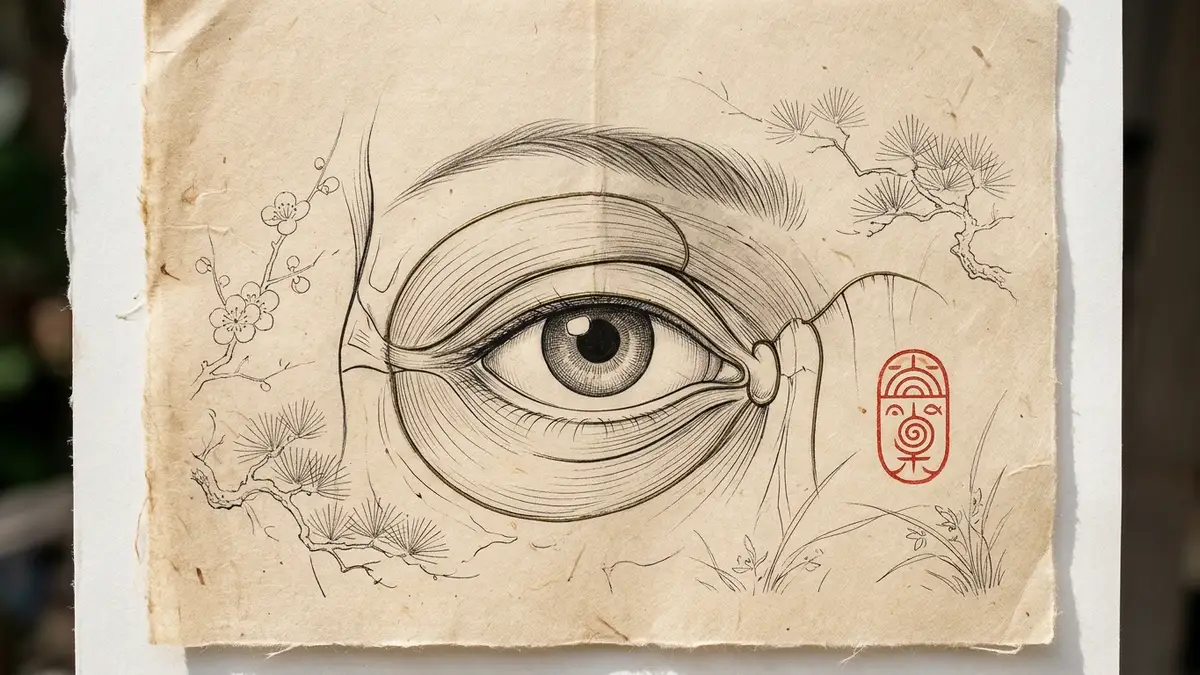
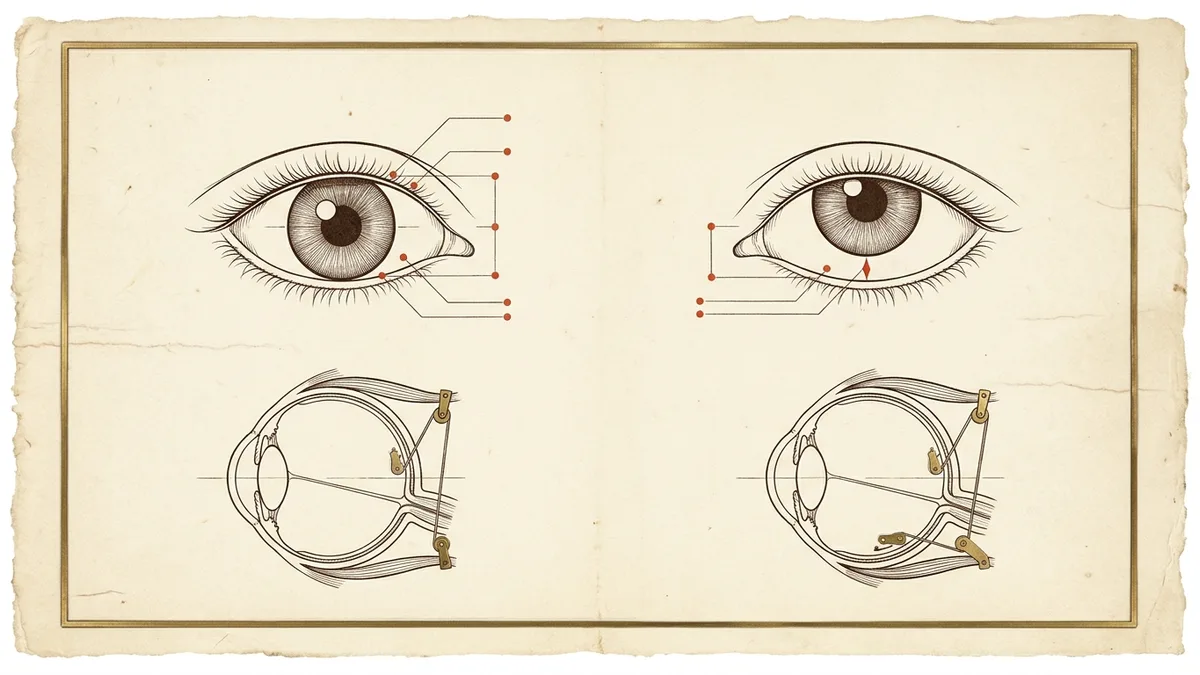
- Eyes — The Observing Officer (Jian Cha Guan, 监察官): Treated as the most expressive officer on the face, judged by gaze steadiness, sclera clarity, and lid support. Subtle variations in eye structure—such as visible sclera below or above the iris, examined in our guide on Sanpaku eyes meaning in face reading—reflect heightened alertness or emotional sensitivity.
- Nose — The Discerning Officer (Shen Bian Guan, 审辨官): Occupying the center of the Middle Courtyard, the bridge, tip, and wings represent judgment, personal standards, and resource management.
- Mouth — The Reception Officer (Chu Na Guan, 出纳官): Observed through lip symmetry, corner alignment, and resting posture. Clear vermilion borders and relaxed corners reflect articulate speech and balanced appetite for social engagement.
In classical theory, one commanding officer cannot carry an unsupported face: a prominent nose surrounded by recessed cheekbones lacks structural backing, just as intense eyes paired with tense, compressed lips suggest internal friction between perception and expression.
The Twelve Palaces (Shi Er Gong): Functional Zones of the Face
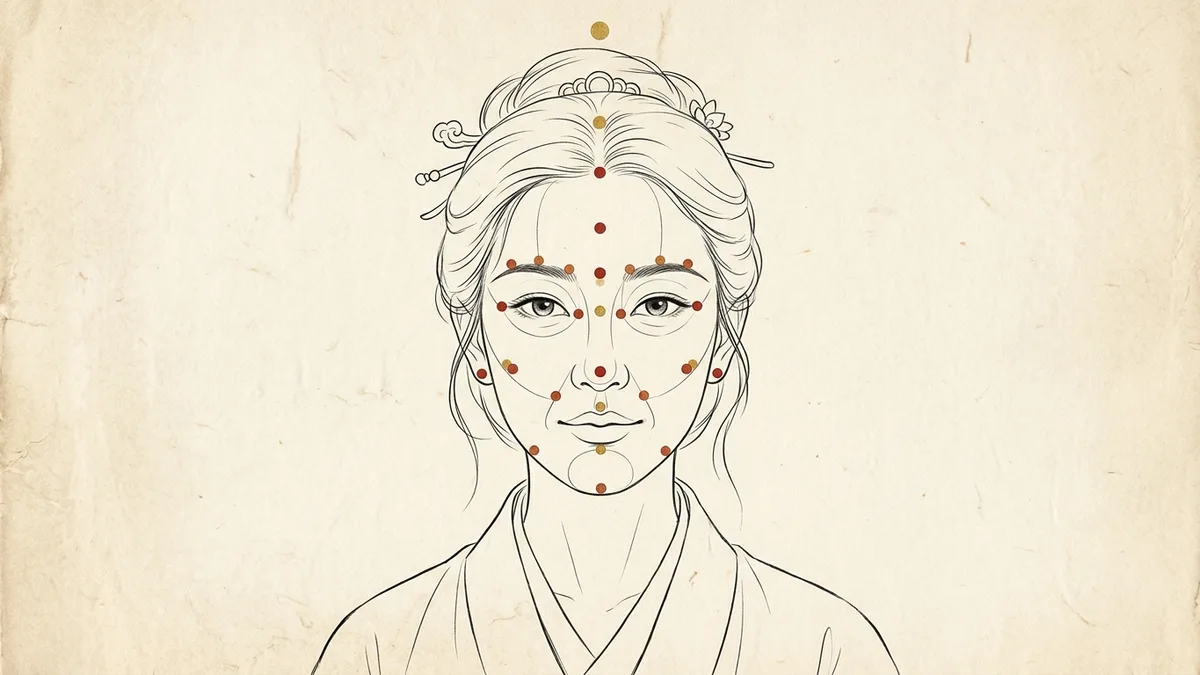
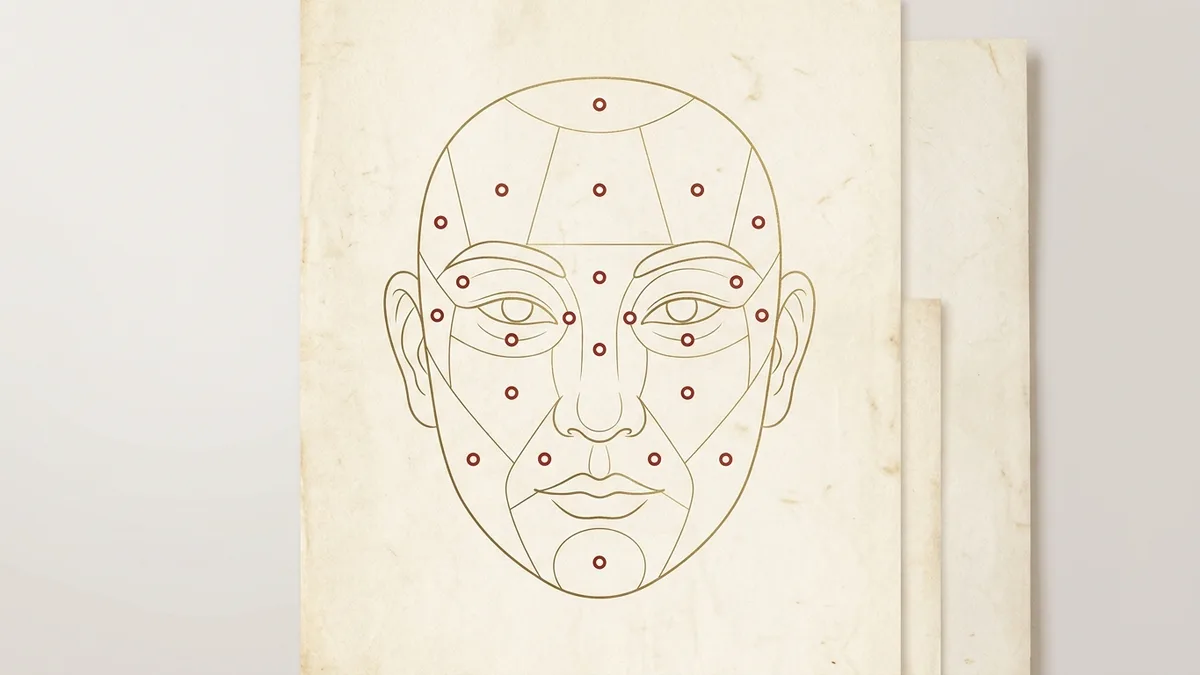
While the Three Courtyards measure vertical rhythm and the Five Officers assess primary features, the Twelve Palaces (Shi Er Gong, 十二宫) divide the face into twelve specific territories corresponding to domains of everyday experience. You can inspect their exact pin coordinates on our interactive Chinese face reading chart, look up Pinyin definitions in the Mian Xiang face reading glossary, or test any portrait in the interactive Mian Xiang Twelve Palaces analyzer.
| Palace Name | Chinese Term | Anatomical Location | Classical Focus |
|---|---|---|---|
| Life Palace | 命宫 (Ming Gong) | Between the eyebrows (Yin Tang) | Core outlook, decision clarity, adaptability |
| Wealth Palace | 财帛宫 (Cai Bo Gong) | Nose tip and surrounding nostrils | Earning rhythm, stewardship, financial habits |
| Siblings Palace | 兄弟宫 (Xiong Di Gong) | The eyebrows and immediate brow ridge | Peer rapport, sibling ties, emotional steadiness |
| Marriage Palace | 夫妻宫 (Fu Qi Gong) | Outer corners of the eyes (Yu Wei) | Romantic partnership, domestic harmony |
| Children Palace | 子女宫 (Zi Nu Gong) | Lower eyelid fullness (Wo Can) | Nurturing instinct, creative vitality, family warmth |
| Vitality & Stamina Palace | 疾厄宫 (Ji E Gong) | Upper nose bridge between the eyes (Shan Gen) | Everyday vitality, stamina reserves, rest rhythm |
| Travel Palace | 迁移宫 (Qian Yi Gong) | Outer forehead above the brow tails | Mobility, adaptability to new environments |
| Servants Palace | 奴仆宫 (Nu Pu Gong) | Lower cheeks and outer jawline | Rapport with teams, supporters, younger colleagues |
| Career Palace | 官禄宫 (Guan Lu Gong) | Center of the forehead | Public standing, leadership path, vocation |
| Property Palace | 田宅宫 (Tian Zhai Gong) | Space between eyebrow and upper eyelid | Home stability, living environment, accumulation |
| Fortune & Virtue Palace | 福德宫 (Fu De Gong) | Upper outer corners above the eyebrow arches | Inner contentment, perspective, leisure balance |
| Parents Palace | 父母宫 (Fu Mu Gong) | Left and right upper forehead (Ri Yue Jiao) | Early mentorship, inherited habits, family roots |
Reading Zones in Context
Notice how the Twelve Palaces depend on three-dimensional contour as much as surface color. In classical observation, an ideal palace is open, smoothly fleshed, and free of deep horizontal creases or harsh shadowing—a sign that the corresponding sphere of life flows without chronic strain. For instance, an open, uncreased Yin Tang (Life Palace) suggests calm mental bandwidth, while a smooth, well-supported Shan Gen (Vitality & Stamina Palace) reflects steady stamina reserves and disciplined rest habits rather than chronic overwork.
Historical Lineage Note: In the original Ma Yi Shen Xiang (麻衣神相), the twelfth palace was Xiang Mao Gong (相貌宫, Overall Visage), while Fu Mu Gong (父母宫, Sun & Moon Eminences) became the standard twelfth seat in later popular compendia; likewise, San Ting Wu Yan (三停五眼, Three Courtyards & Five Eyes) draws from classical Chinese portrait-painting canons (画论) alongside physiognomic treatises.
Mian Xiang vs. Face Reading in Chinese Medicine
Because both systems inspect facial regions with meticulous care, readers often ask how Mian Xiang relates to face reading in Chinese medicine. Historically, the two traditions shared a vocabulary of Qi (气, vital energy) and Se (色, complexion), yet their methods, goals, and timeframes differ fundamentally.
Structural Physiognomy vs. Clinical Inspection (Wang Zhen)
In Traditional Chinese Medicine, visual examination—known as Wang Zhen (望诊)—is one of the Four Examinations (Si Zhen), codified as early as the Huangdi Neijing (黄帝内经, Yellow Emperor's Inner Canon). A TCM practitioner observes dynamic, changeable signs: facial pallor, localized redness, puffiness, lip dryness, or the sheen of the sclera. In the Ling Shu chapter on facial zones, regions such as the forehead, nose tip, and cheeks serve as micro-indicators of immediate internal equilibrium, hydration, sleep quality, and fatigue.
Mian Xiang, by contrast, is primarily structural and biographical. Its core data points—cranial height across the Three Courtyards, ear placement, bone prominence across the zygomatic arch, and nose-bridge architecture—change very slowly over decades. While a physiognomer also notes temporary Qi Se (surface radiance or dullness) to gauge a person's current momentum, the discipline remains a cultural cartography of character, habit, and life-stage pacing rather than a medical assessment.
Keeping this boundary clear honors both traditions: Wang Zhen belongs to clinical wellness practitioners trained to evaluate physiological balance, whereas Mian Xiang offers a reflective, museum-grade vocabulary for studying proportion, expression, and self-awareness. Review a complete specimen face reading report or upload a level photograph to the interactive Mian Xiang Twelve Palaces analyzer to see how all three systems align on real geometry.