三停San Ting
San Ting (Three Courtyards)
Structural DivisionsLocus
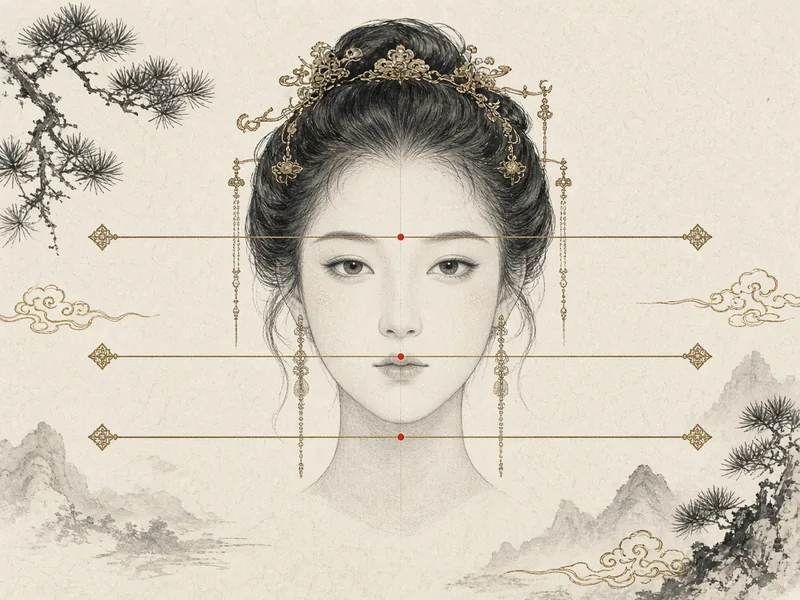
Horizontal tripartite division spanning hairline to glabella, glabella to subnasale, and subnasale to menton
In Mian Xiang face reading, San Ting divides the frontal visage into Upper, Middle, and Lower Courtyards. Classical manuals test whether all three tiers approach 1:1:1 equilibrium, interpreting marked dominance in one courtyard as temperament pacing across life stages rather than fixed fate.
五官Wu Guan
Wu Guan (Five Officers)
Five OfficersLocus
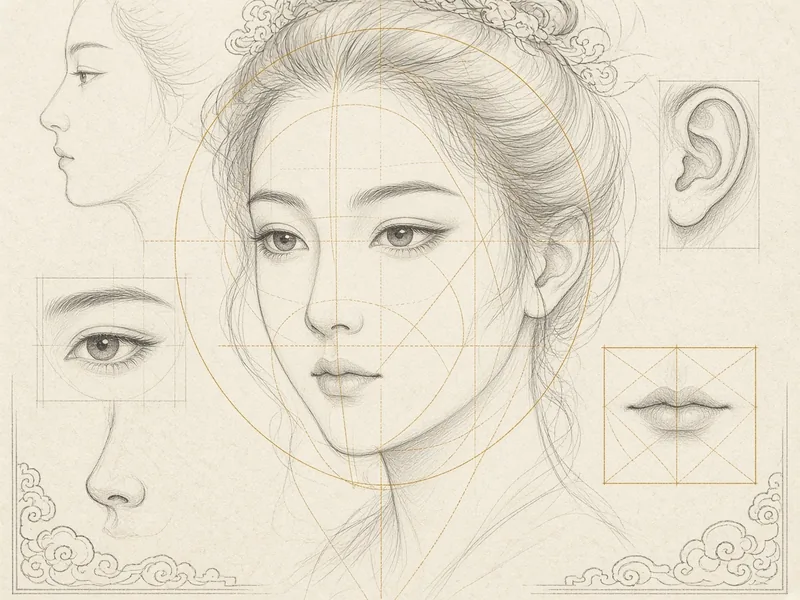
The five sensory and structural portals: eyebrows, eyes, nose, mouth, and ears
Wu Guan classifies the five primary sensory features as court stewards holding distinct perceptual and expressive duties. Following Ma Yi Shen Xiang, classical face reading weighs mutual proportion and support among all five offices rather than grading any single feature in isolation.
十二宫Shi Er Gong
Shi Er Gong (Twelve Palaces)
Twelve PalacesLocus
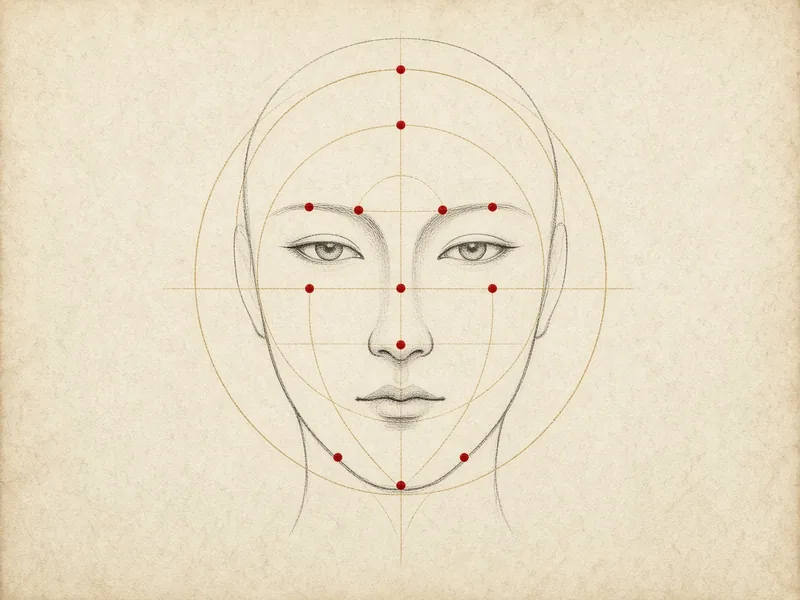
Twelve mapped anatomical zones distributed across the forehead, orbits, nose, cheeks, and jaw
Codified in Shen Xiang Quan Bian, Shi Er Gong anchors Mian Xiang face reading by mapping twelve experiential domains onto specific bony and soft-tissue seats. Used in archival study as a spatial atlas, it links regional contour clarity with household, social, and vocational themes.
印堂Yin Tang
Yin Tang (Hall of the Seal)
Twelve PalacesLocus
Central glabellar interval between the medial heads of the eyebrows
Serving as the seat of Ming Gong (the Palace of Life), Yin Tang marks the central threshold between Upper and Middle Courtyards. Classical treatises prized a broad, uncrowded glabella, viewing deep vertical furrows there as a subtle register of sustained mental strain.
山根Shan Gen
Shan Gen (Mountain Root)
Key Landmarks & Eye FormsLocus
Superior nasal root bridge nestled between the medial canthi of the eyes
Corresponding anatomically to the nasion and upper nasal bone bridge, Shan Gen connects the frontal vault to the central nasal pillar in Mian Xiang face reading. Commentators value smooth, continuous elevation here as a quiet index of everyday vitality, stamina reserves, and rest rhythm.
天庭Tian Ting
Tian Ting (Heavenly Courtyard)
Structural DivisionsLocus
Uppermost median plane of the frontal bone directly beneath the anterior hairline
As the crown seat of the Upper Courtyard above Guan Lu Gong, Tian Ting signifies breadth of perspective and early intellectual poise. An expansive, gently domed forehead was compared in Song portraiture to an open pavilion hall valued for uncluttered symmetry.
地阁Di Ge
Di Ge (Earthly Pavilion)
Structural DivisionsLocus
Anterior mandibular prominence forming the chin and lower jawline base
Counterbalancing Tian Ting along the lower sagittal axis, Di Ge anchors the Lower Courtyard in classical proportion theory. Manuals esteem a rounded, cohesive chin seated firmly beneath the mouth, associating its breadth with endurance, grounded habits, and measured follow-through.
准头Zhun Tou
Zhun Tou (Nasal Apex)
Key Landmarks & Eye FormsLocus
Distal rounded tip of the nose flanked by the left and right alar wings
Occupying the central focal point of the Palace of Resources (Cai Bo Gong), Zhun Tou serves as the nasal apex in Mian Xiang face reading. Classical authors examined its rounded fullness and clear tone alongside flanking nasal wings to gauge practical stewardship.
人中Ren Zhong
Ren Zhong (The Philtrum)
Key Landmarks & Eye FormsLocus
Vertical midline groove descending from the subnasale to the Cupid's bow of the upper lip
Positioned as a vertical channel uniting Middle and Lower Courtyards, Ren Zhong acts as the central conduit above the upper lip. Treatises prize a clearly etched, balanced philtrum flanked by crisp ridges, treating its definition as an emblem of constitutional poise.
卧蚕Wo Can
Wo Can (Silkworm Fold)
Key Landmarks & Eye FormsLocus
Smooth pre-tarsal muscular cushion hugging the inferior margin of the lower eyelashes
Distinct from lower-orbital puffiness or recessed tear troughs, Wo Can describes the taut muscular crescent formed beneath the lower lashes during a calm smile. Classical face reading associates this subtle contour with expressive warmth, empathy, and harmonious rapport.
三白眼(下三白 / 上三白)San Bai Yan
Sanpaku (Xia San Bai / Shang San Bai)
Key Landmarks & Eye FormsLocus
Ocular sclera exposure visible beneath (Xia San Bai) or above (Shang San Bai) the iris in neutral forward gaze
Sanpaku denotes visible white sclera along three borders of the iris during level eye-height fixation. While modern folklore often dramatizes the trait, archival Mian Xiang face reading treatises examine upper or lower scleral show primarily alongside gaze steadiness (Shen) and lid tension.
桃花眼Tao Hua Yan
Tao Hua Yan (Peach-Blossom Eye)
Key Landmarks & Eye FormsLocus
Long, gently undulating palpebral aperture with softly curving lids and luminous sclera-iris contrast
Celebrated in Song poetry and portrait manuals, Tao Hua Yan combines a hooked inner canthus, rounded lid dome, and soft outer sweep resembling a peach petal. Commentators link its luminous gaze with interpersonal magnetism balanced by surrounding brow poise.
凤眼Feng Yan
Feng Yan (Phoenix Eye)
Key Landmarks & Eye FormsLocus
Slender, elongated ocular fissure tapering into a crisp, subtly lifted lateral canthus
Among the highest-esteemed ocular forms in Song and Ming canons, Feng Yan defines streamlined horizontal length and serene iris focus. Defined lid folds and composed upward canthal alignment linked the Phoenix Eye with discernment and executive restraint.
保寿官Bao Shou Guan
Bao Shou Guan (Guardian of Longevity)
Five OfficersLocus
The eyebrows, spanning the bilateral supraorbital ridges
Assigned to the eyebrows within the Wu Guan system, Bao Shou Guan serves as a canopy framing the eyes and a barometer of steady temperament. Observers note hair grain continuity, lateral extension past the outer canthus, and underlying supraorbital support.
监察官Jian Cha Guan
Jian Cha Guan (Observing Officer)
Five OfficersLocus
The paired orbital apertures, irises, and palpebral lids
Governing the eyes in Mian Xiang face reading, Jian Cha Guan ranks foremost among the five offices because it conveys gathered mental clarity, or Shen. Classical treatises emphasize calm pupil focus, clear iris-sclera contrast, and bilateral lid symmetry.
审辨官Shen Bian Guan
Shen Bian Guan (Arbiter of Discernment)
Five OfficersLocus
The central nasal column from Shan Gen to Zhun Tou and flanking alae
Attributed to the nose along the sagittal midline, Shen Bian Guan anchors Middle Courtyard architecture. Ma Yi Shen Xiang links an upright dorsal ridge and balanced cheekbones with measured judgment and structural coherence.
出纳官Chu Na Guan
Chu Na Guan (Portal of Exchange)
Five OfficersLocus
The upper and lower lips, vermilion line, and oral commissures
Assigned to the mouth, Chu Na Guan frames speech and intake as regulated exchange across the Lower Courtyard. Classical face reading manuals inspect distinct vermilion borders, balanced upper-to-lower lip volume, and relaxed resting commissures.
采听官Cai Ting Guan
Cai Ting Guan (Auditor of Counsel)
Five OfficersLocus
The paired auricles, outer helices, inner ridges, and earlobes
Belonging to the ears, Cai Ting Guan associates auricular contour with receptive listening and early formative grounding. Standards benchmark upper helix height against the brow line alongside firm cartilage folds and un-pinched earlobes.
法令纹Fa Ling Wen
Fa Ling Lines (Nasolabial Folds)
Key Landmarks & Eye FormsLocus
Paired diagonal creases descending from the nasal alae past the outer corners of the mouth
Named after legal decrees and authoritative bearing, Fa Ling Lines denote the bilateral nasolabial folds flanking the oral aperture in Mian Xiang face reading. Commentators examine their symmetry, openness around the mouth corners, and wide downward arc.
五行形格Wu Xing Xing Ge
Wu Xing Bone Phases (Five-Element Typology)
Structural DivisionsLocus
Global cranial-facial silhouette integrating skull vault, zygomatic breadth, and jaw geometry
Wu Xing Bone Phases classify overall visages across Wood, Fire, Earth, Metal, and Water silhouettes. Rather than expecting a single pure archetype, practitioners evaluate how primary cranial bone contour harmonizes with soft-tissue fullness across all three courtyards.