ARCHIVAL TOPOGRAPHY FOLIO

Chinese Face Reading Chart: Classical Palaces & Proportion Map

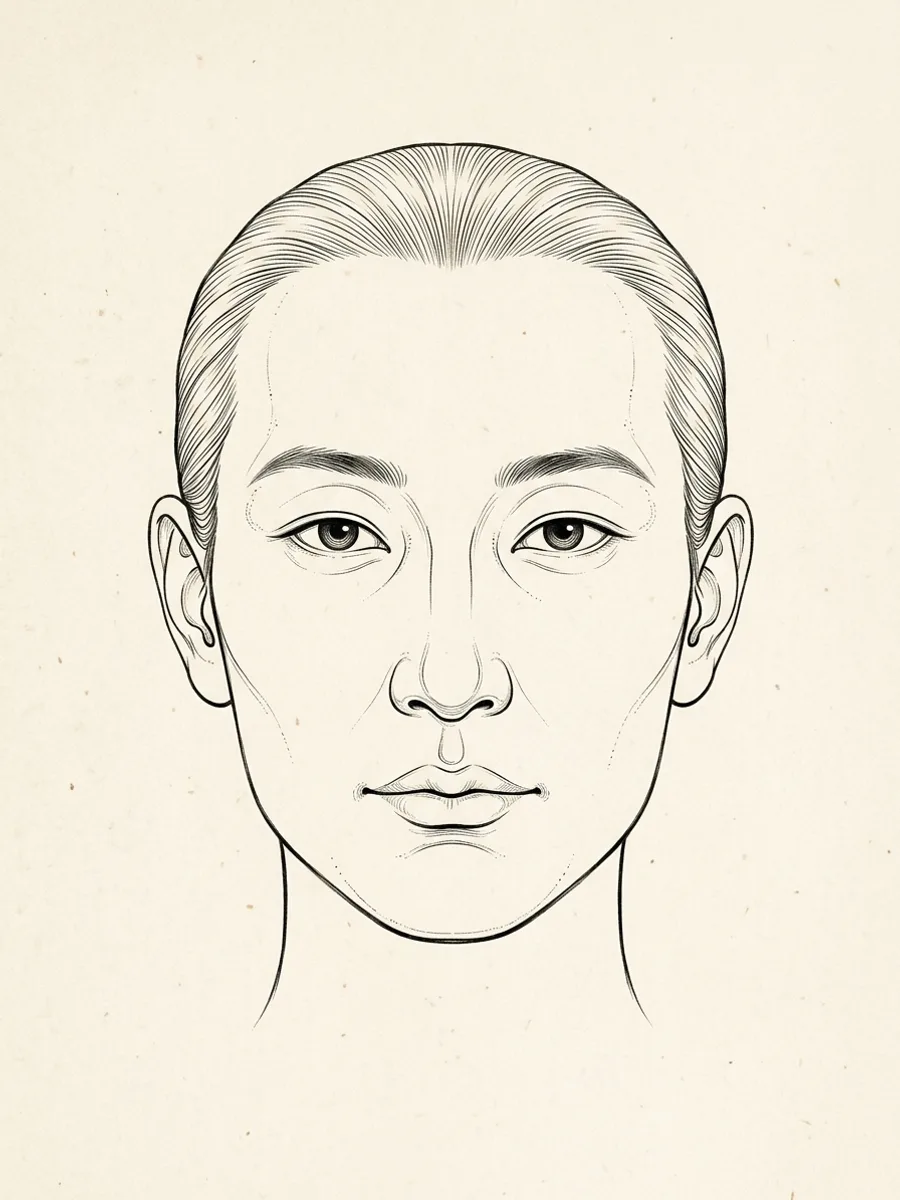
A classical Chinese face reading chart arranges the human visage into an orderly spatial atlas rather than a scattered list of isolated traits. By indexing San Ting vertical thirds, Wu Guan sensory officers, and Shi Er Gong zones on a single Song-style plate, this interactive face reading chart lets you locate exact anatomical coordinates from hairline to chin and cross-reference traditional canons against 478-landmark calipers.

Song-dynasty archival Mian Xiang facial proportion diagram mapping the Three Courtyards, Five Officers, and Twelve Palaces

Click any seal pin on the Song-dynasty folio above to inspect its classical canon.

命宫

Ming Gong

Palace of Life · Yin Tang

Locus 50.0% · 38.8%

Anatomical Locus

Smooth glabellar plane directly between the medial heads of the two eyebrows

1. Anatomical Observation

Situated at the crossroads of the brow line and sagittal axis, this compact interval separates the two orbital arches. Anatomically, its width is benchmarked at roughly 1.0 to 1.3 eye widths (about 1.5 to 2 finger-breadths) relative to the nasal bridge.

2. Classical Canon

Regarded in Ma Yi Shen Xiang as the central seal (Yin Tang) reflecting overall composure and clarity of outlook. Classical guides prefer an open, unobstructed surface free of crowding brow hairs or deep vertical furrows.

3. Cultural Perspective

Called the Hall of the Seal in imperial imagery, it served as the threshold where inward equanimity first reveals itself.

COMPLETE SPATIAL TAXONOMY

Twelve Palaces Ledger on the Chinese Face Reading Chart

Each row in this Shi Er Gong ledger pins an exact anatomical seat on our Chinese face reading chart, pairing its Song-dynasty title with modern thematic context. Tracing from Guan Lu Gong on the central forehead through Yin Tang (Palace of Life), Zhun Tou, and Di Ge keeps vocation, composure, vitality rhythm, and resource stewardship clearly bounded across the reading chart.

Palace & HanziLocusClassical Canon
命宫

Palace of Life · Yin Tang

Ming Gong

Smooth glabellar plane directly between the medial heads of the two eyebrowsRegarded in Ma Yi Shen Xiang as the central seal (Yin Tang) reflecting overall composure and clarity of outlook. Classical guides prefer an open, unobstructed surface free of crowding brow hairs or deep vertical furrows.
财帛宫

Palace of Resources · Nasal Vault

Cai Bo Gong

Nasal apex (Zhun Tou) flanked bilaterally by the left and right nasal alae (Lan Tai and Ting Wei)Classical manuals assign resource stewardship and material equilibrium to this nasal cluster. A well-cushioned apex paired with balanced wings is traditionally read as orderly capacity rather than speculative excess.
官禄宫

Palace of Vocation · Central Forehead

Guan Lu Gong

Median frontal prominence centered halfway between the hairline and the glabellaIn imperial-era treatises, Guan Lu Gong denoted public standing, civic aptitude, and continuity of craft. A luminous, unscarred frontal plane was associated with clear direction and disciplined ambition.
田宅宫

Palace of Dwelling · Upper Eyelid

Tian Zhai Gong

Preseptal and orbital upper eyelid area spanning between the brow margin and upper lash lineTitled Tian Zhai Gong in Shen Xiang Quan Bian (originally framed around the eyes as a whole, Wei Ju Liang Yan, and focused in later manuals on the upper eyelid interval), this seat reflects domestic stability, sanctuary, and ancestral grounding.
夫妻宫

Palace of Partnership · Outer Canthus

Fu Qi Gong

Lateral canthal region and adjacent temple hollow (Yu Wei and Jian Men)Classical texts identify the Fish Tail (Yu Wei) and Outer Canthus Gate (Jian Men) as the locus of domestic harmony and enduring companionship. Even, gently cushioned temples without hollowing were read as emblems of relational steadiness.
子女宫

Palace of Posterity · Infraorbital Fold

Zi Nu Gong

Suborbital lower eyelid band (Wo Can / Lei Tang) curving directly beneath the lower lashesKnown as Zi Nu Gong or Silkworm Fold, this region is linked in classical manuals to vitality, nurturing warmth, and generational continuity. Smooth, softly rounded fullness was traditionally considered auspicious for familial care.
兄弟宫

Palace of Kinship · Brow Arch

Xiong Di Gong

Full longitudinal sweep of both eyebrows across the supraorbital ridgeAssigned to Xiong Di Gong in Ma Yi Shen Xiang, the eyebrows symbolize peer camaraderie, sibling bonds, and cooperative temperament. Cohesive, smooth-lying hairs were favored over sparse or fractured arches.
父母宫

Palace of Lineage · Sun & Moon Eminences

Fu Mu Gong

Bilateral upper frontal eminences (Ri Jiao and Yue Jiao) flanking the central foreheadKnown as the Sun and Moon Corners (Ri Yue Jiao), these regions represent paternal and maternal lineage in classical iconography (joining the Twelve Palaces alongside the older Ma Yi Shen Xiang 12th palace, Xiang Mao Gong / Overall Visage). Balanced convexity without sharp depressions was linked to respectful filial continuity.
迁移宫

Palace of Movement · Temporal Margin

Qian Yi Gong

Lateral upper forehead and post-orbital temple margins bordering the hairline (Yi Ma)Titled Qian Yi Gong and colloquially linked to the Post-Horse (Yi Ma) zone, it corresponds to travel, transitions, and broader horizons. Open, well-filled temporal margins signified ease when navigating unfamiliar surroundings.
疾厄宫

Vitality & Stamina Palace · Nasal Bridge Root

Ji E Gong

Nasal root (Shan Gen) between the inner canthi descending along the upper bony dorsumIn Shen Xiang Quan Bian, Ji E Gong relates to constitutional resilience and how an individual weathers strain. Treatises value an unbroken, gently elevated bridge free of harsh transverse creases.
交友宫

Palace of Fellowship · Lower Mandibular Flanking

Jiao You Gong

Paired lower cheek and mandibular margin zones flanking the chin toward the jaw anglesTraditionally termed Nu Pu Gong and in modern scholarship Jiao You Gong, this base denotes collaboration, loyal fellowship, and practical support. Rounded, well-supported cheeks flanking the chin symbolize dependable alliances.
福德宫

Palace of Equanimity · Supra-Lateral Brow Ridge

Fu De Gong

Bilateral zones resting directly above the lateral third and tail of each eyebrowCalled Fu De Gong in Ma Yi Shen Xiang, this palace embodies cultivated composure, quiet contentment, and ancestral grace. Treatises associate balanced, unwrinkled lateral brow ridges with inner serenity.
CRANIAL SILHOUETTE TYPOLOGY

Five-Phase Silhouettes & Eight Classical Frames

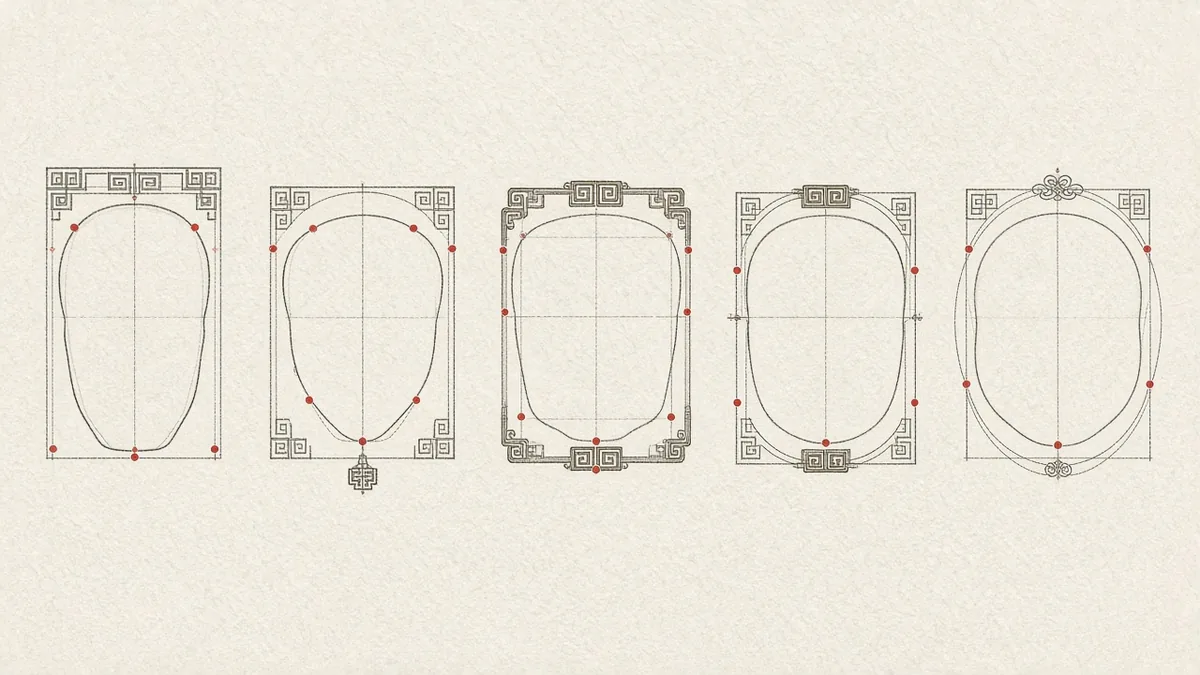
Before evaluating subtle lines or surface marks on a Chinese face reading chart, classical examiners classify overall cranial contour using Wu Xing elemental phases and Ba Ge script frames. Comparing forehead breadth, cheekbone prominence, and mandibular taper gives essential structural context to every local zone on the face reading chart.

Song-dynasty comparative cranial silhouette plate contrasting Wood, Fire, Earth, Metal, and Water frontal facial frames
木形格Mu Xing

Wood Phase Contour

Elongated vertical proportion with a lofty forehead, visible bony articulation, and slender jaw taper.

Associated in classical manuals with scholarly deliberation, structural height, and upward-branching composure.

火形格Huo Xing

Fire Phase Contour

Narrower, tapering upper forehead expanding downward into a broader cheek-and-jaw base with crisp angular poise.

Defined in Ma Yi Shen Xiang as tapering above and broad below (Shang Jian Xia Kuo), linked to decisive momentum and expressive responsiveness.

土形格Tu Xing

Earth Phase Contour

Dense, broad horizontal breadth across forehead, cheekbones, and squared jaw with deep soft-tissue fullness.

Interpreted in classical treatises as an emblem of steadiness, grounded temperament, and unhurried endurance.

金形格Jin Xing

Metal Phase Contour

Crisp rectangular geometry marked by clean-cut orbital rims, level brow ridges, and defined gonial angles.

Traditionally read as reflecting disciplined proportion, measured restraint, and clear axial symmetry.

水形格Shui Xing

Water Phase Contour

Rounded, fluid curvature throughout the temples, malar pads, and chin with minimal angular bone protrusion.

Associated in Song-era physiognomy with adaptability, diplomatic ease, and continuous rhythmic flow.

甲字面Jia Zi

Jia-Script Frame

Broad upper forehead tapering gracefully toward a refined, narrower chin.

申字面Shen Zi

Shen-Script Frame

Widest across the zygomatic arches, tapering gently toward both the upper temple and the lower jaw.

田字面Tian Zi

Tian-Script Frame

Compact square proportions uniting a broad brow, level cheekbones, and sturdy mandibular breadth.

由字面You Zi

You-Script Frame

Narrower upper forehead expanding downward into full buccal cheeks and a broad, weighted lower jaw.

同字面Tong Zi

Tong-Script Frame

Elongated rectangular symmetry with parallel lateral planes descending from temple to jaw corner.

王字面Wang Zi

Wang-Script Frame

Pronounced horizontal bone tiers across the supraorbital ridge, zygoma, and angular mandible.

圆字面Yuan Zi

Yuan-Script Frame

Continuous circular curvature across forehead, cheeks, and chin with softened osseous transitions.

目字面Mu Zi

Mu-Script Frame

High vertical aspect ratio featuring a tall frontal plane, slender mid-face width, and extended lower third.

Diagram Guide

How to Read a Chinese Face Reading Chart Step by Step

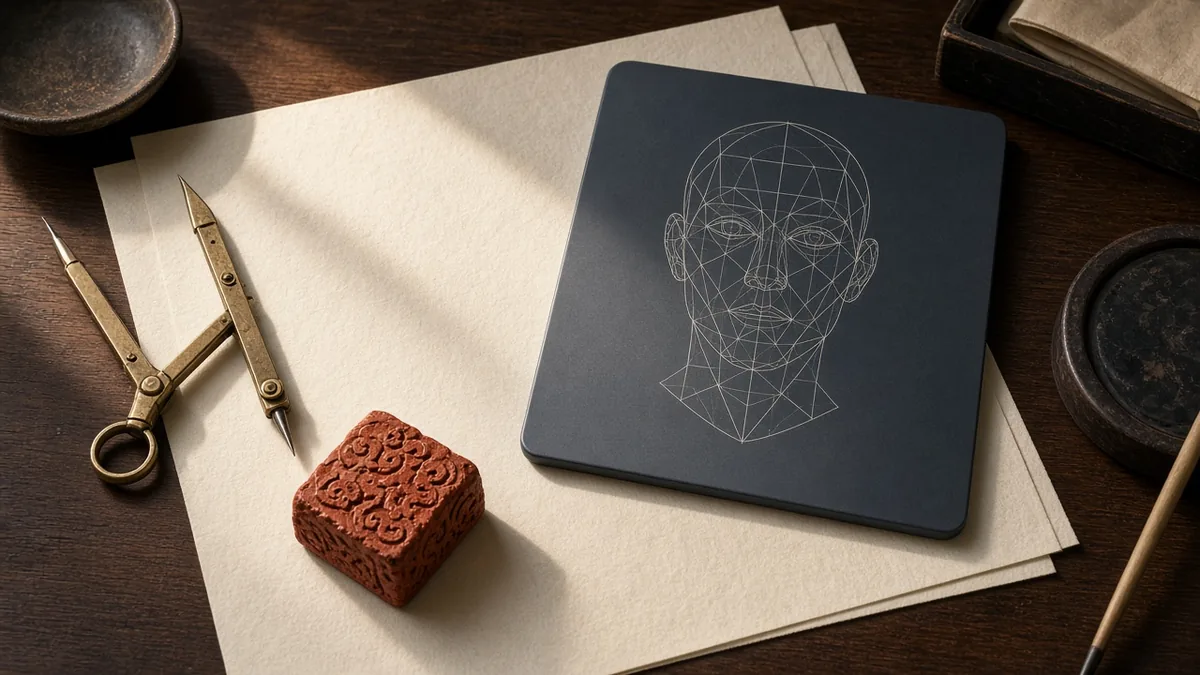
Moving methodically from macro silhouette down to individual palace seats prevents common misreadings when comparing an archival Chinese face reading chart against a live portrait.

Brass proportional dividers beside a 478-point geometric facial mesh slate on archival Xuan paper

01. Survey Macro Proportions First

Begin by checking overall cranial silhouette and the Three Courtyards division across the Chinese face reading chart before zooming into smaller traits. Measuring whether upper, middle, or lower thirds dominate clarifies which life chapter carries primary structural emphasis.

02. Weigh the Five Sensory Officers

Next, inspect how the Wu Guan—ears, brows, eyes, nose, and mouth—sit in mutual proportion on the Chinese face reading chart. Classical texts prize balanced support among all five officers over isolated prominence in a single feature, pairing gaze clarity with nasal stability and calm lip poise.

03. Trace the Twelve Thematic Palaces

Review the twelve palace seats plotted on the Chinese face reading chart, noting contour smoothness and bilateral parity at each locus. Guan Lu Gong on the central forehead reflects vocation, Yin Tang between the brows anchors the Palace of Life, and Shan Gen registers everyday rest rhythm.

04. Verify Ratios with Live Landmarks

Bridge printed diagrams with quantitative geometry by testing a level portrait against our Chinese face reading chart inside the local 478-landmark studio. Twelve deterministic calipers measure forehead span, interocular ratio, and jaw breadth so visual face reading observations align with repeatable coordinates.

COORDINATE CALIBRATION

Midline & Bilateral Landmarks in Song Face Reading Charts

Historical woodblock plates organize every Chinese face reading chart along two intersecting axes—the central sagittal spine and paired bilateral wings—so adjacent zones never blur together.

The Sagittal Midline Axis

Running vertically down the center of the Chinese face reading chart from Tian Ting through Guan Lu Gong, Yin Tang, Shan Gen, Zhun Tou, Ren Zhong, and Di Ge, the midline anchors core composure, vitality pacing, and structural balance.

Paired Orbital & Temporal Seats

Radiating outward from the central axis on the face reading chart, bilateral zones—including Tian Zhai Gong on the upper lids, Zi Nu Gong beneath the lashes, Yu Wei at the outer canthus, and Qian Yi Gong at the temples—frame domestic and social spheres.

Bone Support Over Surface Detail

Manuals such as Shen Xiang Quan Bian emphasize underlying bone support (Gu Xiang) ahead of transient skin tone on a face reading chart, reminding readers to evaluate frontal, zygomatic, and mandibular balance as an integrated whole.

Level Orthographic Reference

Because upward or downward camera pitch compresses one courtyard while stretching another, aligning portraits to eye-level posture is essential when comparing live photographs against a classical Chinese face reading chart.

Interactive Mapping

Project the Chinese Face Reading Chart onto Your Portrait

Open the browser-local studio to project our Chinese face reading chart—including Twelve Palaces, Three Courtyards, and twelve geometric calipers—onto your own photograph, privately computed on your device with one-click Download Full Report PDF export.

FAQ

Chinese Face Reading Chart Questions

How are the Twelve Palaces arranged on a Chinese face reading chart?+

On a traditional Chinese face reading chart, the Twelve Palaces follow a vertical and bilateral coordinate map from hairline to jaw: Guan Lu Gong (Career) occupies the central forehead, Yin Tang between the inner brows anchors Ming Gong (Palace of Life), Shan Gen marks Health and rest rhythm, Zhun Tou anchors Resources, and paired orbital and temporal zones map Partnership, Kinship, Dwelling, and Travel.

How does left versus right symmetry work on a face reading chart?+

Classical face reading commentary compares left and right hemispheres alongside central midline landmarks on a Chinese face reading chart to distinguish resting bone symmetry from expressive habit. Modern caliper mapping normalizes slight head roll first so bilateral differences reflect genuine anatomy rather than camera tilt.

Does a Chinese face reading chart map age stages across the Three Courtyards?+

Yes. Traditional San Ting doctrine on a Chinese face reading chart correlates the Upper Courtyard with formative youth and conceptual study, the Middle Courtyard with prime adult agency and execution, and the Lower Courtyard with mature consolidation and household steadiness.

Why do the Five Officers matter when consulting a face reading chart?+

The Five Officers—ears, brows, eyes, nose, and mouth—act as structural pillars on any Chinese face reading chart, governing perception, discernment, and expression. Evaluating all five together keeps individual palace notes anchored in whole-portrait harmony.

How are facial moles read on a classical face reading chart?+

In Zhi Xiang tradition, surface luster and border clarity take precedence over location alone, and any mark plotted on a Chinese face reading chart is weighed as a secondary accent within its underlying Shi Er Gong zone rather than an isolated omen.

What do Five-Phase silhouettes add to a Chinese face reading chart?+

Wu Xing silhouettes—Wood, Fire, Earth, Metal, and Water—classify broad bone and soft-tissue contour on a Chinese face reading chart before local landmarks are examined, clarifying whether a portrait leans toward elongated Wood framing, crisp Metal symmetry, or rounded Water fullness.

How does a printed face reading chart differ from 478-point live mapping?+

A static Chinese face reading chart illustrates ideal canonical proportions on a generalized head, whereas live 478-landmark mapping adapts those exact Three Courtyards and Twelve Palaces boundaries onto your individual brow arch, nasal root, and jawline.